Monday, September 30, 2019

Mavericks ranked third

Minnesota State is No. 3 in the first USCHO rankings of the season, which came out on Monday morning. The Mavericks received one first-place vote in the poll. The other 49 went to No. 1 Minnesota Duluth.

Bowling Green, at No. 17, was the only other WCHA team in the top 20. Northern Michigan, Bemidji State and Lake Superior State received votes.

USCHO.com Division I Men's Poll
Minneapolis, Minn./September 30, 2019

   Team             (First Place)    Record   Pts  Last Week
 1 Minnesota Duluth          (49)   29-11-2   996    NR
 2 Denver                           24-12-5   891    NR
 3 Minnesota State           ( 1)   32- 8-2   788    NR
 4 Massachusetts                    31-10-0   737    NR
 5 Cornell                          21-11-4   673    NR
 6 St. Cloud                        30- 6-3   566    NR
 7 Providence                       24-12-6   550    NR
 8 Quinnipiac                       26-10-2   526    NR
 9 Notre Dame                       23-14-3   509    NR
10 Clarkson                         26-11-2   500    NR
11 Boston College                   14-22-3   466    NR
12 Ohio State                       20-11-5   449    NR
13 Penn State                       22-15-2   406    NR
14 Western Michigan                 21-15-1   371    NR
15 Northeastern                     27-11-1   359    NR
16 Wisconsin                        14-18-5   300    NR
17 Bowling Green                    25-11-5   283    NR
18 North Dakota                     18-17-2   211    NR
19 Harvard                          19-11-3   195    NR
20 Arizona State                    21-13-1   181    NR

Others receiving votes: Minnesota 142, AIC 116, Boston
University 94, UMass Lowell 88, Michigan 40, Northern
Michigan 20, Brown 9, Colorado College 9, Omaha 7, Dartmouth
6, Bemidji State 3, Lake Superior 3, Maine 3, Air Force 1,
Niagara 1, Union 1.

Wednesday, September 18, 2019

Mavericks picked first by WCHA coaches

The choice was easy — and as unanimous as it could be.

After losing just one regular player from last season’s Western Collegiate Hockey Association regular-season and playoff title team, the Minnesota State men’s hockey team was picked to once again be the league champion by the league’s coaches.

(For an updated story, go here.)

The Mavericks, who went 32-8-2 (22-5-1 in WCHA) last season, received the maximum 90 points on nine first-place votes in the eighth annual Mankato Free Press WCHA Preseason Coaches Poll. Coaches could not vote for their own teams.

The Mavericks also were picked in the poll’s preseason player and rookie of the year voting, with senior forward Marc Michaelis and freshman forward Nathan Smith receiving the honors.

Bowling Green was picked second with 82 points and had the other first-place vote.

From there, coaches are expecting another tight race with just five points separating third through sixth place. Bemidji State was third with 63 points, followed by Northern Michigan with 61, Michigan Tech with 59 and Lake Superior State with 58.

Alaska was picked seventh with 39 points, and Ferris State was eighth with 38. Alabama Huntsville was ninth with 30 points., and Alaska Anchorage rounded out the poll with 20.

Michaelis received nine of 10 votes in preseason player of the year voting. The native of Mannheim, Germany, had 42 points last season, including 19 goals, in 42 games, with 10 goals and 24 points coming in conference play. In three seasons at MSU, Michaelis has racked up 51 goals and 118 points in 117 games.

Smith got eight votes for the rookie award. The Hudson, Florida, native comes to MSU from Cedar Rapids of the USHL where he led the RoughRiders in scoring with 18 goals and 53 points in 59 games last season. He is a 2018 third-round draft pick of the Winnipeg Jets.

The Preseason All-WCHA Team included Michaelis and two MSU teammates, fellow senior forward Parker Tuomie and sophomore goaltender Dryden McKay. Bowling Green had two players, junior forward Brandon Kruse and senior defenseman Alec Rauhauser. Northern Michigan senior Philip Beaulieu was the other defenseman.

Here are the results of the poll:

Place Team Points (1st place)
1. Minnesota State 90 (9)
2. Bowling Green 82 (1)
3. Bemidji State 63
4. Northern Michigan 61
5. Michigan Tech 59
6. Lake Superior State 58
7. Alaska 39
8. Ferris State 38
9. Alabama Huntsville 30
10. Alaska Anchorage 20

Preseason Player of the Year (votes)
Marc Michaelis, F, Minnesota State (9)
Others: Parker Tuomie, F, Minnesota State (1)

Preseason Rookie of the Year (votes)
Nathan Smith, F, Minnesota State (8)
Others, Colby Bukes, D, Minnesota State (1); Samuel Solensky, F, Bemidji State (1)

Preseason All-WCHA (votes)
F—Marc Michaelis, MSU (10)
F—Parker Tuomie, MSU (9)
F—Brandon Kruse, BGSU (6)
D—Philip Beaulieu, NMU (9)
D—Alec Rauhauser, BGSU (5)
G—Dryden McKay, MSU (9)
Others: F—Max Johnson, BGSU (3), Brian Halonen, MTU (1), Max Humitz, LSSU (1); D—Connor Mackey, MSU (4), Collin Saccoman, LSSU (1), Ian Scheid, MSU (1); G—Matt Jurusik, MTU (1)

Tuesday, July 23, 2019

New players, new team

Minnesota State's men's hockey roster for 2019-20 has been posted, and it includes jersey numbers for the new players.

The seven incoming rookies are:

1-Jaxson Stauber, G
8-Nathan Smith, F
12-Colby Bukes, D
14-Ryan Sandelin, F
21-Lucas Sowder, F
27-Tony Malinowski, D
28-Cade Borchardt, F

The Mavericks graduated just three seniors from last year's team, one who played regularly in forward Max Coatta. The others were Ryan Schwalbe and Alec Vanko, who played both forward and defense over their time at MSU.

Also missing from last year's roster are goaltender Mathias Israelsson, who signed a pro contract in Sweden despite having a year of eligibility left, and defensemen Michael Bigelbach and Zak Galambos, both of whom saw limited playing time in their time at MSU. Bigelbach played in seven games as a freshmen but none over the last two years. Galambos appeared in four games last season, his first year of college hockey.

That still leaves a very competitive lineup for next season. Speculation in July about who's going to play where seems like a fool's errand.

The Mavericks will have: seven seniors -- Tuomie, Gerard, Scheid, Michaelis, Rivera, Hookenson and French; eight juniors -- Mackey, McNeely, Jaremko, Spooner, Lutz, Duehr, Gerads and Zmolek; and seven sophomores -- Carroll, Aamodt, McMahan, Napravnik, Van Os-Shaw, McKay and Berger.

Broken down by position, there are: 17 forwards -- Tuomie, Gerard, Michaelis, Rivera, French, Jaremko, Spooner, Lutz, Gerads, Duehr, McMahan, Napravnik, Van Os-Shaw, Smith, Sandelin, Sowder and Borchardt; nine defensemen -- Scheid, Hookenson, Zmolek, Mackey, McNeely, Aamodt, Carroll, Bukes and Malinowski; three goaltenders -- McKay, Berger and Stauber.

Friday, June 28, 2019

Wither, WCHA?

If July 11, 2011 was the end of the WCHA as we knew it (that was when the formation of the NCHC was first announced), June 28, 2019 might mark the beginning of the end of the WCHA altogether.

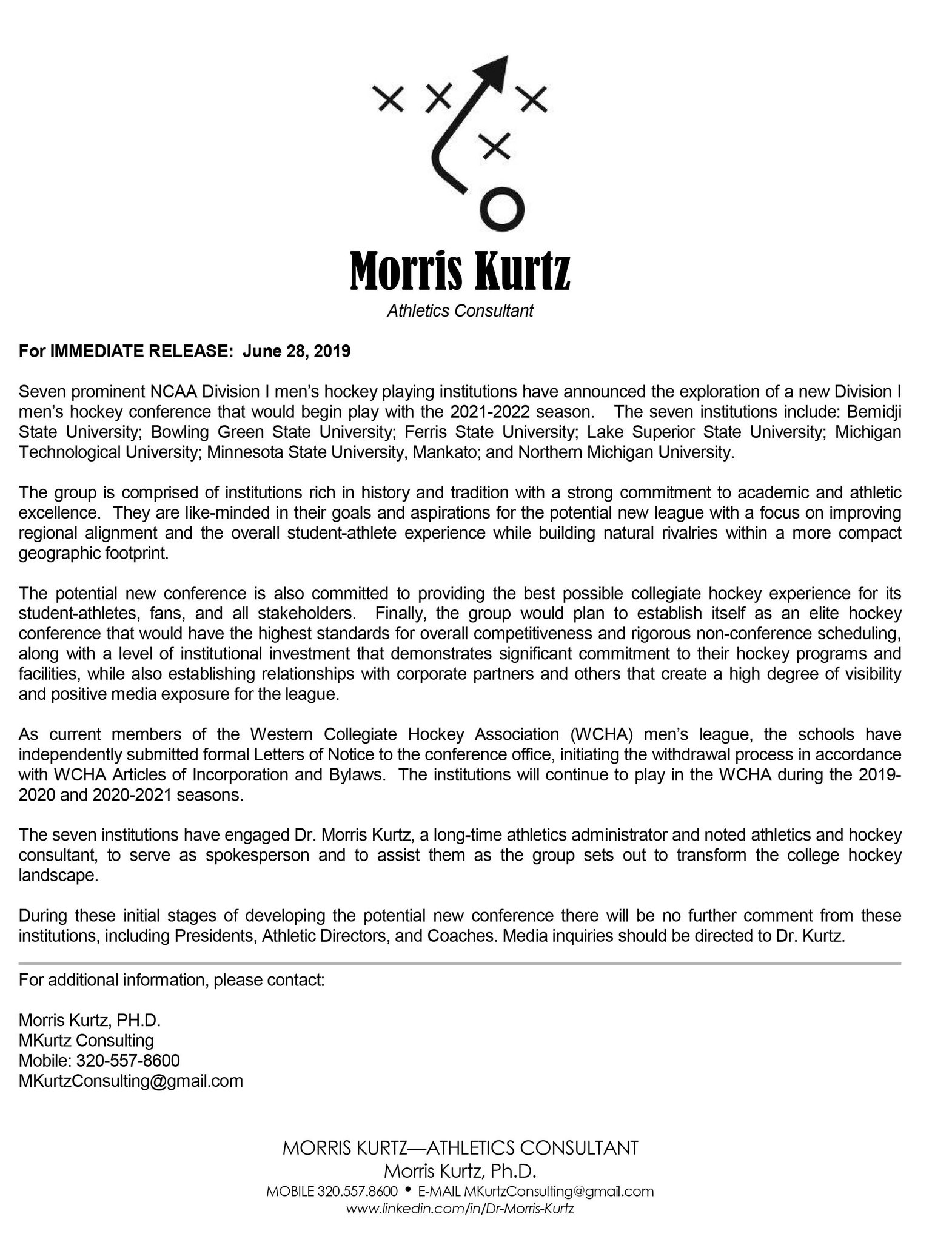
A group of seven WCHA teams, including Minnesota State, are exploring forming a new, "elite hockey conference" that would begin play in 2021-22, according to a press release sent out by athletics consultant Morris Kurtz, the former St. Cloud State athletic director.

Minnesota State, Bemidji State, Bowling Green, Ferris State, Lake Superior State, Michigan Tech and Northern Michigan are the teams, which means they are planning to move on without Alaska, Alaska Anchorage and Alabama Huntsville.

The wheels are clearly in motion on this, as, according to the press release, all seven schools have "submitted formal Letters of Notice to the confernece office, initiating the withdrawal process in accordance with WCHA Articles of Incorporation and Bylaws." The schools intend to play in the league this coming season and in 2020-21.

In a statement issued by the WCHA, commissioner Bill Robertson said: “While this news is disappointing, the WCHA will work to assure that any members that do withdraw do so in accordance with WCHA Bylaws.”

The press release, which came out around 3:30 p.m. CDT Friday, refers all inquires to Kurtz and said the seven institutions' representatives, including presidents, ADs and coaches, would not be commenting.

The release said the seven schools "are like-minded in their goals and aspirations for the potential new league with a focus on improving regional alignment and the overall student-athlete experience while building natural rivalries within a more compact geographic footprint."

The seven schools are located in Minnesota, Michigan and Ohio. The Alaskas and UAH are the conference's geographic outliers. Also, the Alaskas have major financial issues, made worse today by a $130 million cut to the university system's budget in a governor's veto. Huntsville, meanwhile, is without an AD after E.J. Brophy was reassigned to a new position earlier this month.

The new league also would "establish itself as an elite hockey conference that would have the highest standards for overall competitiveness and rigorous non-conference scheduling, along with a level of institutional investment that demonstrates significant commitment to their hockey programs and facilities, while also establishing relationships with corporate partners and others that create a high degree of visibility and positive media exposure for the league."

Sounds a lot like what we heard when the NCHC schools left the WCHA and CCHA to form a new conference in reaction to the formation of the Big Ten. Those conferences began play in 2013, as did the new WCHA.

I have more thoughts on this but am on vacation right now, so keep checking the blog throughout the next week.

Monday, June 3, 2019

WCHA names new women's commissioner

The Western Collegiate Hockey Association looked to the Northern Sun Intercollegiate Conference to find its next women's commissioner.

Jennifer Flowers was named WCHA vice president and women's commissioner on Monday. Flowers has been the NSIC's assistant commissioner for membership services since August of 2016. She will be the WCHA's fourth women's commissioner.

Northern Sun members Minnesota State, St. Cloud State, Bemidji State, Minnesota Duluth all have WCHA women's programs.

Flowers, who will begin her WCHA duties in July, replaces Katie Million, who was with the conference for three years before recently taking a job with USA Hockey.

“Jennifer stood out among an outstanding group of finalists," Mavericks coach John Harrington, a member of the selection committee, said in a league press release. "Her previous experience in administration with coaches, athletic directors and faculty representatives shows she can build relationships and involve key stakeholders in the decision-making process. Her vision to continually address and improve the student-athlete experience in the WCHA is important as we move forward under her leadership.”

During her time at the NSIC, Flowers spearheaded a committee that created the league’s first transgender student-athlete participation guidelines and coordinated the launch of the league’s SAAC Cup, which was designed to encourage engagement of campus student-athlete advisory councils. She also developed and implemented the NSIC Women’s Coaches Symposium in 2017, which has since been rebranded the NSIC Women’s Leadership Symposium.

Besides her NSIC duties, Flowers, serves on the NCAA women’s volleyball rules committee, is the co-chair of the Minnesota Coalition for Women in Athletic Leadership and serves as a mentor in the Women Leaders in College Sports mentoring program.

From 2012 to 2015, Flowers worked as an associate athletic director and senior woman administrator in the second of two stints at Winona State. She was also an assistant women’s basketball and volleyball coach at Simpson College in 2005-06.

Wednesday, May 29, 2019

Seawolves moving games to campus

Alaska Anchorage announced on Wednesday that it is leaving Sullivan Arena after more than 30 years and will play games starting this coming season at its practice rink in the on-campus Wells Fargo Sports Complex.

The reason for the move is financial as, according to the press release, "state budget cuts require the university to evaluate its venue needs." The release said the Wells Fargo rink will be expanded to a 2,500-seat facility by 2021. Currently it holds only 750 seats. Sullivan Arena holds about 6,200, although UAA averaged 1,944 fans per game last season.

The WCHA issued a statement in support of the move, saying, "given the current budget climate in Alaska ... (the league) views it as a step towards strengthening the long-term viability of the Alaska Anchorage men’s hockey program." The statement added that UAA has assured the WCHA that the facility will meet all league and NCAA requirements for hosting games.

The future of the Alaska programs has been in question over the last couple of years due to the financial issues in that state.

Earlier this spring, Alaska Fairbanks announced that it will remain in that city's Carlson Center this upcoming season, but is looking to move back on campus within two years. One reason for that is the Carlson Center's aging ice plant. The Patty Ice Arena at UAF will serve as a backup home arena this season. The Carlson seats 4,324 for hockey, while the Patty has seating for 1,047. The linked story from March said no renovation plans for the on-campus rink were announced but that the WCHA requires its arenas to have at least 2,500 seats.

According to an attendance list on USCHO, there were 13 arenas in men's college hockey last season that had seating under 2,500. They were:

Brown, 2,495
Ferris State, 2,490
Air Force, 2,470
Union, 2,225
Colgate, 2,222
Princeton, 2,100
Bentley, 1,917
Canisius, 1,800
Niagara, 1,800
Robert Morris, 1,589
Holy Cross, 1,400
Mercyhurst, 1,300
Arizona State, 747

Here were the sizes of the WCHA arenas (does not include standing room):

Alabama Huntsville 6,600
Alaska Anchorage, 6,206
Bowling Green, 5,000
Minnesota State, 4,832
Bemidji State, 4,373
Alaska, 4,324
Michigan Tech, 4,466
Northern Michigan, 3,754
Lake Superior State, 3,373
Ferris State, 2,490

In some good news on the arena front, Alabama Huntsville is exploring building a new arena.

Monday, May 20, 2019

Sioux Falls, with MSU connections, wins Clark Cup

Photo courtesy Rylan Galiardi
The Sioux Falls Stampede won the Clark Cup as the United States Hockey League’s playoff champion on Friday night. 

The Stampede, which had four connections to Minnesota State, crusied through the postseason by winning 11 of 12 games. The team's MSU include alum Rylan Galiardi, an assistant coach (at left in photo), and three future Mavericks (pictured from left after Galiardi): forward Brenden Olson, goaltender Jaxson Stauber and forward Cade Borchardt.

Stauber was named the Clark Cup’s Most Valuable Player, going 11-1 with an impressive .941 save percentage and 1.46 goals-against average in the playoffs. 

I had a chance to talk to Galiardi on Monday morning, and a column about the Stampede's win and a few future Mavs will post online later tonight on The Free Press' website.